

Young professor uses social media to discuss language learning

Seth Garrett is a college professor and doctorate student in language learning. Photos submitted
By Tom Victoria
Seth Garrett knows the lingo and the psychology behind it. The doctoral student posts YouTube videos for the purposes of critical evaluation and intellectual discourse.
“My channel is called Psycholingo,” he said. “Originally, I wanted to do videos about psychology, education and language learning. I would say the primary focus is on language because my background is in linguistics. My master's degree is applied linguistics and I'm currently finishing my doctorate in second language instruction. I teach English in China. I've been teaching here for 10 years.”
Seth's content includes evaluating others' content and marketing.
“The video that made my channel sort of blow up — I still only have 4,000 subscribers — was a critique on a person selling knowledge about learning the language and that knowledge is freely available online,” he said. “And so one of my critique videos is what kind of made me blow up. I've been coming at language learning from a scientific perspective and trying to help regular people see past all the lies.”
Seth, 36, a Michigan native, explained the person he critiqued wasn't even teaching languages.
“They help clients figure out how to customize their YouTube experience by giving them search terms to use so their YouTube feed/recommended videos will recommend videos that the client believes is at or around their current level in the language they are learning,” he said. “They also offer coaching, but their use of the term is misguided. It seems they coach clients by holding them accountable to studying every day, but that is about it. The biggest reason I believe it is a scam is because what they offer is of almost no value. The person in question has no background in linguistics or language education. They prey on vulnerable, desperate language learners who feel completely lost after repeatedly failing with other methods.”
Seth said learning other languages isn't as difficult as some people claim.
“Learning a language requires motivation, diligence, structure of some sort or scaffolding, high quality input, optimal feedback, among other things,” he said. “In this way, it is complicated. But generally speaking, picking any method and being consistent will lead to results; they will just vary. Some methods might be more appealing to some learners, and learners who use those methods may see better results compared to using better methods. Some would say one method is better over another but there are a number of factors that go into determining which method is appropriate for which learner. The simplistic nature of language is just stick to it. The complicated nature is that everything is dynamic and all the parts are moving at different speeds.”
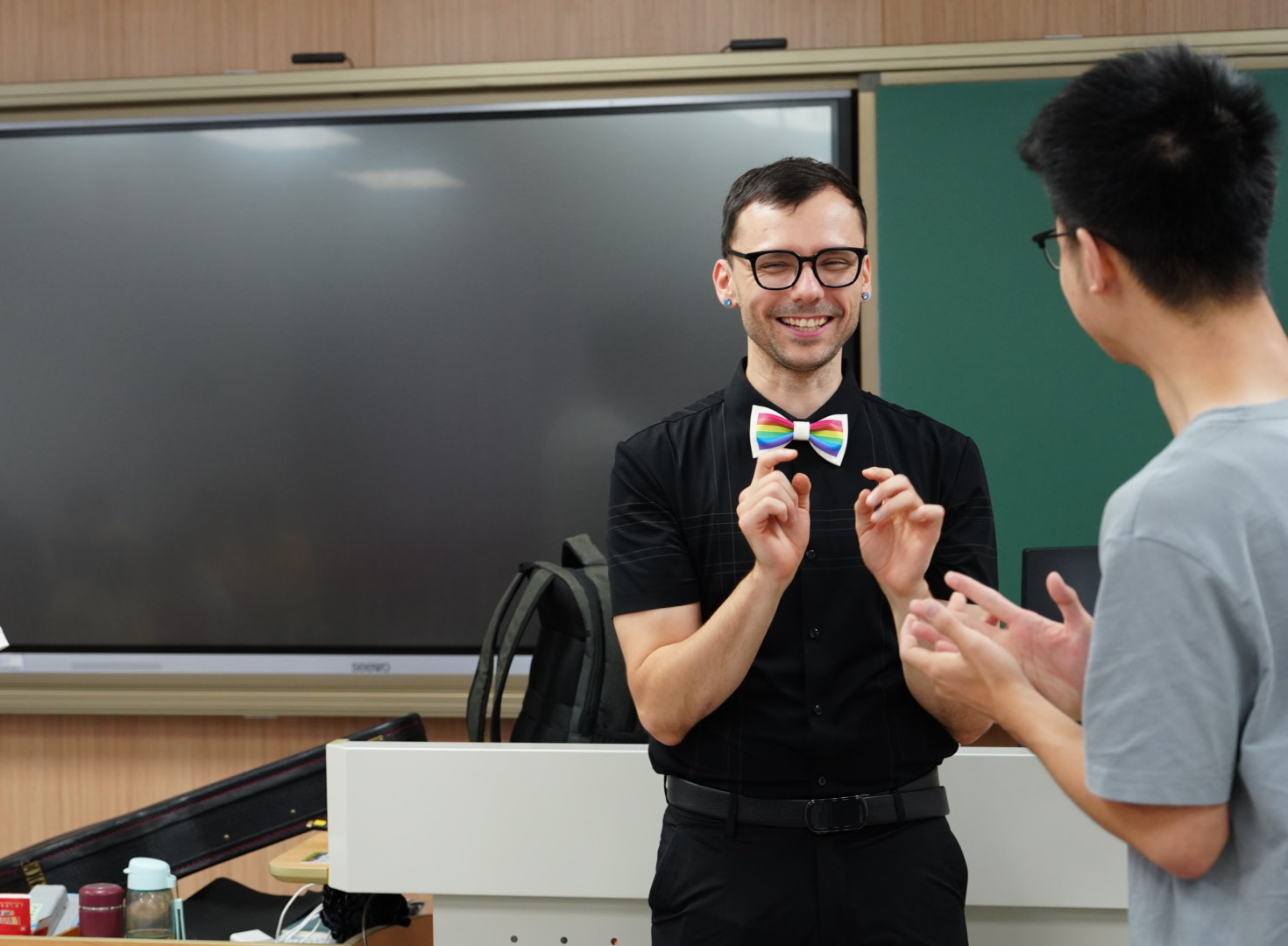
Seth said those learning another language are better motivated when there's a practical purpose to do so.
“I always tell my students the key to language is use and finding a reason to use it,” he said. “Most people when they learn a language, they're doing it for a grade or testing. So normally that doesn't end up very well. It's usually when somebody moves to the country or when they, for some reason in their home, have a reason to use it.”
Seth stressed the importance of reading to enhance language comprehension.
“The majority of adults are literate, but their level of literacy is lower than they think it is,” he said. “One of the problems in America is a lot of adults are very big into research, but when they read research studies, they don't actually comprehend them. They think they comprehend them because they understand each word, but they don't actually understand the idea behind it. Reading is one of the best ways to improve language skills. But there's a difference between basic English or academic English. And if you have basic English skills, you'll appear to be really fluent. You can even appear to be a native speaker. But if you haven't had schooling or education, you won't have academic English skills. So reading can help with that a lot.”
Seth said filler words, such as uh and like, give people time to express their thoughts.
“Most people, it's like our thoughts move faster than what we want to say, so we have to stop for a second to gather ourselves,” he said. “It depends, though. If you've been really trained or you prepared for something, of course you can say it without adding ums and ahs. But otherwise, if you're doing something impromptu, a lot of people will have to use that to give themselves time to think.”
Seth said such an idiosyncrasy of language isn't necessarily associated with native speakers of any area.
“They're really common among native speakers,” he said. “One of my professors when I did my master's program, he did research on the perception of the use of filler words between native speakers and non-native speakers. And the funny thing is people tend to think if you're a native speaker and you say that, that makes you more native. But if you're a foreigner and you use it, you sound more foreign. Even the cadence of their speech is the same or the speed is the same.”
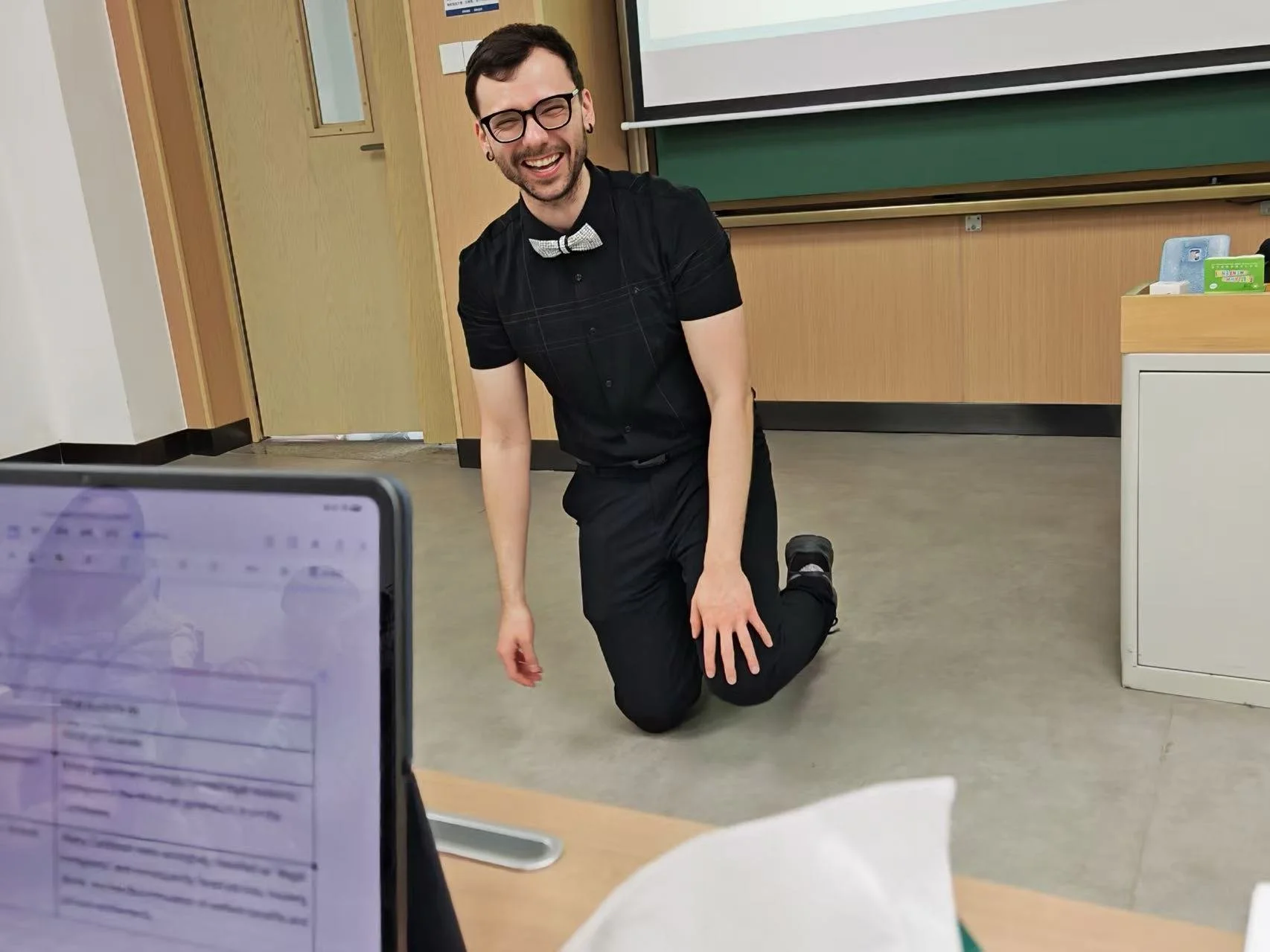
Seth rises after showing his students the bowing practice common in Ancient China.
However, Seth said accents are not as telling at times.
“Obviously, I have an accent,” he said. “Everyone has an accent. But if I speak Chinese and they can't see my face, they don't know that I'm a foreigner. When they see my face, the first reaction is I must be from the Xinjiang province. They can't fathom a foreigner speaking Chinese fluently because most foreigners in China, they don't really speak that fluently.”
Seth said how fast someone speaks can play a role in understanding what is said.
“The rate of speed in talking does have an impact on comprehension, but as is true in any field of research, researchers disagree,” he said. “Some studies have found that lower speech rate can improve comprehension, while others have found that lowering speech rate past a certain point can impede comprehension. I believe that lowering speed too much does a disservice to learners because it trains them to listen to individual words and sounds rather than the gist of a message. It is important to teach students how to navigate unfamiliar territory in language learning. Rather than telling them to know everything they encounter, they can be taught how to deal with things they do not know, and one way is to listen for the gist of a message rather than every minute detail.”
Seth offers his students a less stressful educational environment than is customary.
“I teach Chinese learners,” he said. “I don't know if you know much about the Chinese education system, there is a lot of tyranny I guess you could call it in K through 12 education here. So a lot of students are afraid of their teachers. Fear is the actual word. So when they get to my class, they're usually afraid at first. Once they get to know me, they're not afraid. I give them a lot of choices and freedom and autonomy, and I think that makes them enjoy the learning a little more. When I was younger, I liked school, but I liked school for social aspects. I didn't really like doing classwork or presentations. But as I got older and I had more choice in what I was doing and I had more self-awareness, it just became a lot more enjoyable.”
Seth expects to obtain his doctorate in less than two years.
“I've already had one hiccup because if you saw my latest video on my channel, I was laid off,” he said. “So that caused a hiccup. It's probably going to be February or March of 2028, probably somewhere around there. The job I discussed losing was a university job where I taught undergraduate freshmen College English, which differs from English. College English is a general education course for non-English majors.”

"It's easier to assimilate into Chinese culture compared to Japan or Korea, especially Japan. There's always this barrier between you even if you're born there.”
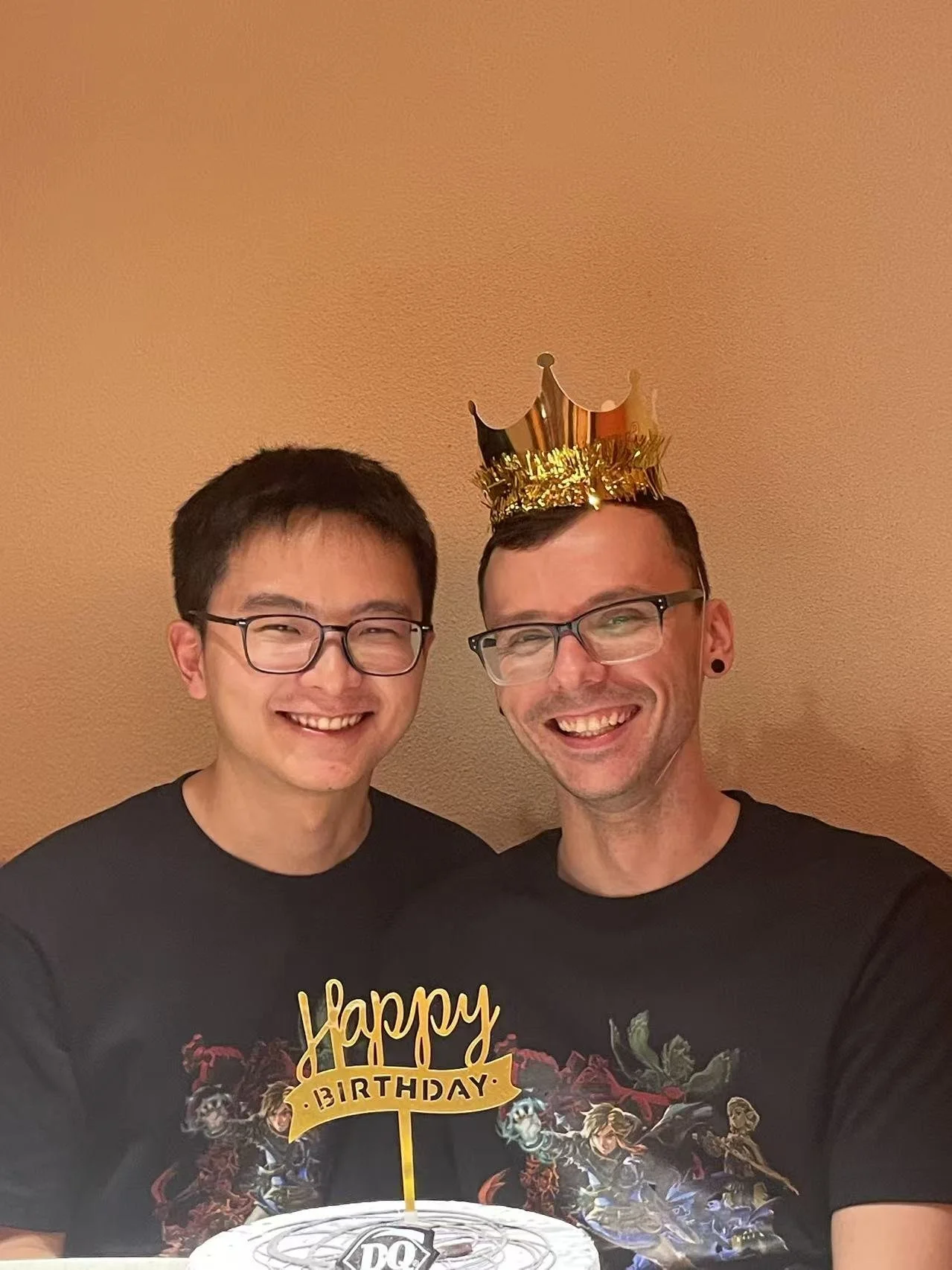
Seth and boyfriend Luke Liu have a birthday celebration with their pooches, shaggy Sammy and Joey. The Chinese symbols spell out Happy Birthday.
However, it didn't take long for Seth to find new work.
“I did get a new job at another university in a different city, so I have to move, but it is kind of a blessing,” he said. “I am being promoted to senior lecturer, which gives me a little more freedom in designing new courses and holding workshops for teachers. That is something I have been wanting to do for a very long time.”
Seth would like to remain in China following the completion of his education.
“I really like life in China,” he said. “It's easier to assimilate into Chinese culture compared to Japan or Korea, especially Japan. There's always this barrier between you even if you're born there. They're parents are foreign, but they're born there and they look foreign. The Japanese people will still treat them like not 100 percent Japanese. China isn't really like that. One of my students, actually his dad is from Israel and he looks Israeli, but his only language is Chinese. No one has ever said to him you're not Chinese. So from a foreign perspective, it's nice because there's a sense of belonging there. I would like to think I would stay in China, but you never know.”
Seth plans on helping folks avoid being taken advantage of in another way.
“I want to start a business here doing educational consulting,” he said. “If you are a Chinese student and you want to go abroad and you apply to an educational consultant, they will charge $30,000 to $40,000. That's highway robbery, really. But parents will feel like they have no opt, so they'll pay it.”
Seth doesn't want to gouge families.
“I'm more ethical,” he said. “I don't want to charge that. I don't need that kind of money to send someone to a college they want to go to.”
Seth initially instructed younger students.
“When I first came, I taught kids in early education kind of like Head Start,” he said. “And then I went to preschool and then to high school and middle school and then eventually to college.”
Seth said Chinese is less difficult to learn than Japanese.
“They would never agree to that,” he said. “But in Chinese, there's no verb conjugations. It's so easy to know. If you're gonna say I eat, you eat, they eat, we eat, it's all the same. Just the subject will change. And Japanese is like that, but they have some alterations if you're trying to be polite or if you're talking to somebody above you or someone below you. Chinese doesn't really do that.”

“My plan was to just stay here for a year. And the easiest way to come to China for work is teaching English. So I did that and I actually fell in love with it. I really liked communicating with people from a different place.”
Seth's biggest adjustment to living in the Middle Kingdom was the focus on guanxi, a network of mutual trust, obligations and reciprocal favors.
“China is a country of guanxi, not a country of rule or law,” he said. “They have laws here. But most people function through this guanxi idea. I still am not used to that. I've been here for 10 years. I still don't like that. I get it a lot of times. Every culture has this concept of saving face, but China, that's really ingrained in their day to day life. If the boss is having a meeting, I'm the kind of person who will call someone out. And Chinese people will not. They will not call the boss out, but I'll do it in the meeting. If you're gonna lie in front of us, I'm gonna call you out in front of us. Some bosses obviously really hate that, but my last job, the boss right above me was really great. She's a really nice person, and she doesn't really tend to bullshit, so if she made a mistake and she asks what our opinions are, I just honestly told her. One time I told her: I really like our school, and I like being with you guys, but our program feels like a shit-show and she laughed with me.”
Seth said there are major advantages to living in China as opposed to the United States.
“One of the appeals to living in China for a foreigner is that the convenience of life is way better than I ever had in the States,” he said. “My friends, they make jokes. The joke is China's a dictatorship and America is totally free. And I tell my friends all the time, I don't see a difference to be honest with you. When I look at people in power, I really don't see democracy anywhere. I see people trying to maintain their power. I just got fruit last night at midnight. It was from the store down the street. I paid $6 or something for two cut trays of watermelon, mango and pineapple. If I did that in the States, it'd probably be $15 to $20 for the fruit. And then you have to pay a tip, and there's a service charge to ask to get it delivered. It costs 30 cents (here). Things like that.”
However, it's not all roses in China for Seth.
“There are other things that are terrible,” he said. “The work culture here is terrible. And sometimes the quality of certain things isn't so nice. There's never hot water outside of the home. If you go to the bathroom somewhere and they have soap, it's always cold water. And if it's winter, it'll be really cold. There's never paper. You always have to bring your own toilet paper somewhere.”
Seth said transportation is better, though.
“Even if I have to go to work, I can take the subway, I can take a bike, I can take a bus,” he said. “And there are bikes downstairs to rent. It's 15 cents to rent for 30 minutes.”
Seth doesn't see much of a military presence imposed on the Chinese public.
“China is interesting because they have a Communist party, but they're more socialist than Communist,” he said. “Communism is the goal. I wouldn't say that I see more soldiers per se, but there is a certain aspect. Last year, two things happened in the city. One was a knife attack in our school. And the other thing was in a district not too far from ours. There was actually a shooting, which is extremely rare in China because people can't have guns. When they made the law of no more guns, give us your guns, people hid the guns. And so some people still have them. There was a shooting. And so because of that, the school made all of the security guards stand in every building, in every hallway. In terms of military presence, it's like out of sight, out of mind. I call it the illusion of freedom or the illusion of safety. Every place has this. Chinese people will say how China is the safest country in the world, which it's not. There are safer. It's very safe, but it's not the safest. I'll ask them if it's the safest, why do you have gates with shards of glass at the top to prevent people from climbing the wall over into your community or you'll have prison bars on the first floor windows of everything and this prevents theft. I get that. But if it's truly safe, do you need that?”
Seth said security varies according to situation and location.
“We go through security when we get onto the train or the subway,” he said. “The train's a little more serious. If you take the subway, you can often get through without actually having to test certain things. Sometimes they'll just wave you through. The only time you sense this military kind of regime is during Covid for example, because they would shut down entire districts and say no one can leave their home in that district. They might close down this whole building in the apartment complex, but then they would actually bring food to the building. It's not entirely crazy, but it's deaf from an American perspective. A lot of people think that it's overreaching.”
Seth said crime isn't unheard of in Chinese communities.
“Street crimes exist, but usually they're things like people get into an argument over something or petty theft, things like that,” he said. “Knife attacks happen, but they're extremely rare. Although the media does cover it, there's very little coverage which again provides this illusion of safety like this doesn't happen, this doesn't occur. But in general, I'd say it's a lot safer than the States. I'm from a small town in America, but I would not dare walk outside after midnight in my town. Whereas in China, 3 a.m. and we want to go to the store, I would go by myself. I would not be afraid.”
Seth was drawn to language learning, which led to his interest in China.
“When I first came to China, I was mainly coming to learn Chinese,” he said. “I had learned Chinese in university for a few years, but I wanted to improve. My plan was to just stay here for a year. And the easiest way to come to China for work is teaching English. So I did that and I actually fell in love with it. I really liked communicating with people from a different place. At the time, I taught little kids. I spoke some Chinese so I could understand them.”
Seth also wanted to dispel falsehoods about language learning.
“There's a lot of myths here,” he said. “They have to learn a language. The majority of people choose English and they have English language learning policies. But there's a lot of myths like the younger you start, the better you are or you have to memorize 10 words every day, 10 new words every day, which will quickly become impossible. The mixture of me enjoying learning from other people, learning about their culture, and then also the mixture of me wanting to correct the wrongs is probably what made me stay. Because even now, we constantly have issues. I'm sure this happens in America, but we have final exams. Do you know what content language integration is? Let's say I'm going to teach you psychology. I'm going to teach you in Chinese. That means you're learning two things. You're learning Chinese, you're learning psychology. One of the issues with those types of classes is it's really difficult to design a test. If I ask you a question in Chinese and you understand it, but you lack the skills to communicate to me, I think you don't know it. So then I'm not really testing your knowledge because you know it. I'm testing your language at that point. It's one of the biggest debates in that field or that part of the field is like: can you truly have a test that has both language and content? And so whenever I give my students any type of assessment, they're allowed to use Chinese. It's their right to use Chinese. And my colleagues disagree, which is funny because whenever we hold meetings about English class, they only do it in Chinese. This is very ironic to me that you would require your students to speak English all the time when you yourself do not.”
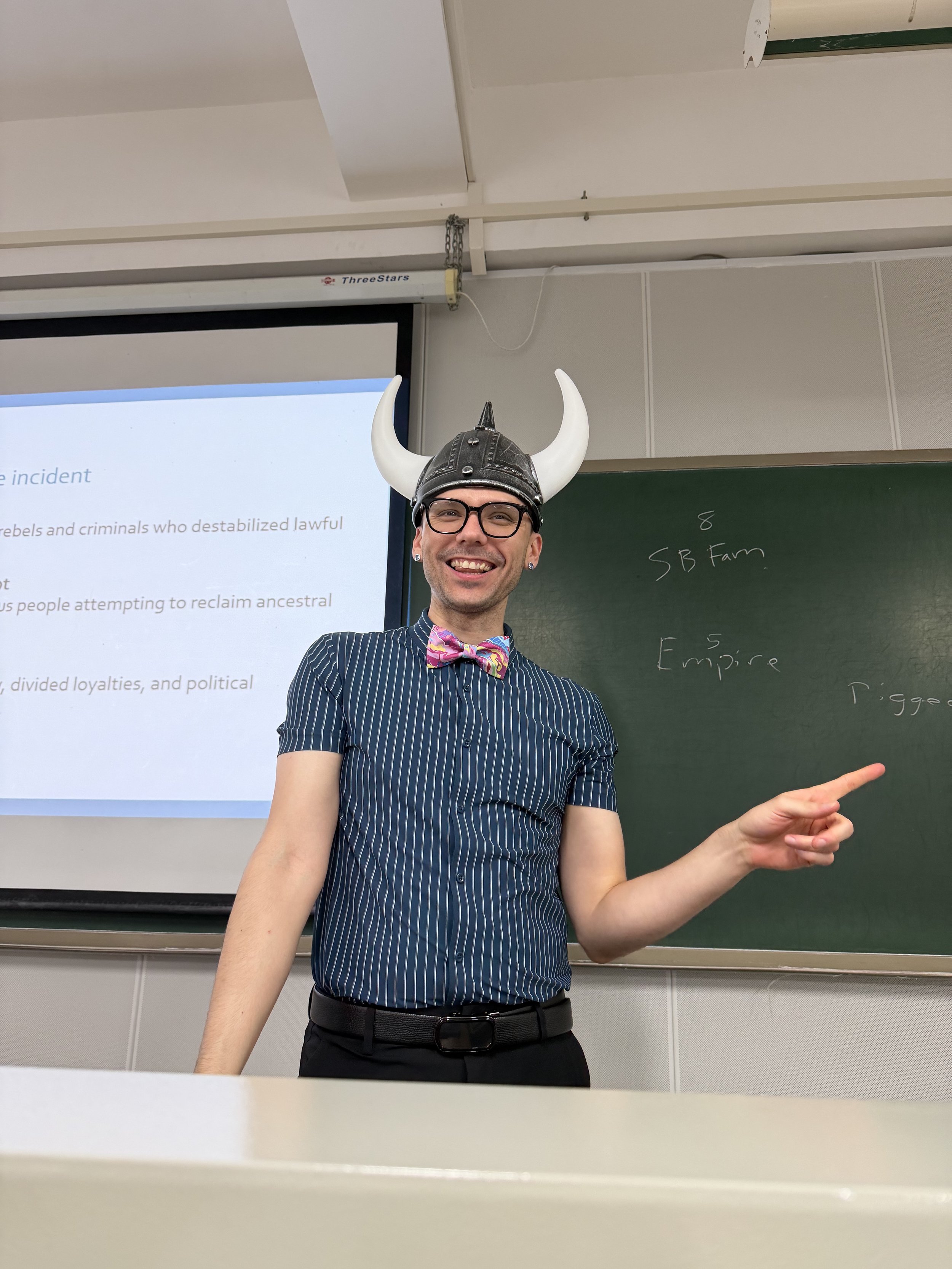
Seth serves as high council during a class simulation using digital game-based learning.
Seth places importance on social justice.
“I push the boundaries a lot,” he said. “We're talking about power and authority in culture, and we're using America and the UK as examples. But students will often draw their own conclusions about their own country. I tell them all the time, you might think our cultures are different, and in some ways they are. But I said most of the time, the underlying mechanisms about what we do is the same, and it's the same thing. We talk about voting. Chinese people can vote, but there really isn't a vote here. But they can vote. Even though Americans vote, I saw a study that said around 30 percent of laws passed by Congress were because of voting. But if you donate money, that increases the likelihood of the law passing. Does voting really matter or does money matter more than voting? Does our voice actually matter in the grand scheme of things?”
Seth discovered medical care is much less expensive in China.
“A high school classmate when he was 24, he died because he couldn't afford his insulin,” he said. “So he had to ration it, and then he ended up dying at 24. That kind of stuff does not happen in China even if you're really poor. I had to get medication. I don't remember what it was for, but I went to the doctor. I had the doctor examine me, and then I went to get medication. The whole trip cost $10, including the medication. And I didn't use any insurance or anything. They have social insurance. I could have used it. I have a card, but I didn't use it because it's so cheap.”
Seth started his YouTube channel to discuss his passion.
“I wanted to do a podcast,” he said. “I would read two studies and then discuss them. I would still like to do that, but I feel like a lot of people who consume YouTube, they're not looking for intellectual conversation, they're looking for emotional debate. Normally, the videos that do the best on my channel are the ones that have involved some type of scandal in the language learning community. I don't really like covering those things. I only do it if for some reason I'm involved, if someone's mentioned me by name or if they're responding to something that I've actually done. You know what fossilization is? It's in language learning. There's a theory, but I don't know if I'd call it that, where if you've learned language and you learn it a certain way, it'll become fossilized. So let's say you learned it the wrong way, then they'll say it's false, fossilized, and you can never fix it. That was the theory that started Applied Linguistics. That was the seminal paper for the field. But the guy who started it, his paper was theoretical and it was just conjecture. He was just saying what he himself has witnessed. But in the last 10 to 15 years, there's been a lot of research showing that it's not set in stone. You can change and you can grow out of it, but people in the community, it's either one or the other because everything in America has to be opposed, and it's at the very ends of the two extremes. Whereas for me, I'm very middle ground.”

Seth said China has some ways to go in terms of inclusivity.
“So the official language from the government is they'll say they view homosexuals as no different than other people and they treat them the same,” he said. “That's the official view. What happens, though, in reality is quite different. There's actually research in higher education in China; it's a mixture of psychology or industrial organizational psychology on heteronormativity in higher education. If somebody doesn't meet heterosexual norms, they tend to be ostracized. Even Chinese citizens have this problem. So academics in higher education will avoid disclosing their personal life. Let's say I'm gay, but I'm pretending to be straight, but I never get married. That can still prevent me from getting a promotion. Surprisingly, a lot of Chinese people can't tell I'm gay. I used to have a previous supervisor. She was the associate dean and she was in charge of our program. She still works there, but she was removed from the dean position. But we got into an argument once because every time we met, even if it was for something different, she would always say don't tell people you're gay. And I was like, you care more about it than I do. And she was like, well, we need to follow the policy. I was like, tell me the name of the policy. I've never heard or seen of any policy about this. And then she's like, oh, it's a hidden policy. If it's hidden, how could the government expect anyone to follow it because they wouldn't know it? In China, bosses are still trying to maintain power. In America, I might be able to get a job at a school because I'm gay, but it's because it looks good to the boss to hire me.”
Seth said China used to be more lenient regarding homosexuality.
“There's been a bit of backsliding for gay rights here,” he said. “There used to be an LGBT center in Beijing that's closed. They used to have pride in Shanghai that's done away with. They want to remove effeminate men from TV. There was a show called Qi Pa Shuo, which can mean a few things, but it's like saying ‘the weirdo says.’ They would have a lot of men who didn't talk about their sexuality, but presumably they were all gay. I think that is off the air now or at least they had talked about canceling it. So for me, I don't want to hide. A lot of times when people ask me to, I'll tell them you don't pay me to hide. I'm not getting paid for that.”
Seth makes that point clear in other ways as well.
“My background photo on my phone is my boyfriend,” he said. “The back of my phone is Sailor Moon. I have AirPods. It's also Sailor Moon. Part of coming out is also helping to change people's view of it. When people know that I'm gay, at first they think, oh, he's got a disease, there's something wrong with him. If they know me first and then they find out I'm gay, they're like, oh, you're normal. Because they in their minds, they think homosexuals are not normal.”
Seth met his boyfriend Luke Liu in China.
“My boyfriend is from Hunan,” he said. “We've been together for five years, known each other for seven and are very much in love. Many people here comment on our relationship because of how much we express our affection for one another. Chinese people tend to be a bit more reserved in their relationships. They don't really tell each other how they feel, and a lot of their relationships are based on expectations and norms set by society, usually through interactions with family members and the media. But my partner and I do not follow these norms. We tell each other exactly how we feel and we are honest about it. We always kiss when we say goodbye regardless of who is around. I refuse to change my behavior with my partner just because it makes others uncomfortable.”

Seth stays motivated to make content.
“Usually, I'm the most motivated if I feel irritation or anger,” he said. “For example, somebody says something I disagree with, it's somebody's misrepresenting something or somebody, that kind of anger. Or I really can't stand when people use their educational background as a reason to believe them. So when someone says I'm Dr. so-and-so. You should judge an argument based on the argument itself, not based on who's presenting it. In academics, they pretty much will say I'm an expert in this and blah, blah, blah. That means nothing to me. I always tell my students, just because I have specialized knowledge in a field doesn't mean I know everything in my field. And it doesn't mean you don't know something. You might know something I don't know. I'm very willing to have these open discussions, but I feel like people aren't. So a lot of times my motivation comes from wanting to challenge people.”
Seth dispensed advice for those wanting to follow his career path.
“To get into my field, you have to have an advanced degree,” he said. “If you wanted to work in China, you really only need a master's degree. A doctorate doesn't hurt, but it can sometimes hurt. I've had interviews with people who have lower degrees than me. I don't care about that, but they do. It makes them feel embarrassed because I have advanced knowledge. They might ask a question that tells me they don't know what they're talking about. You have to be very careful because you don't want to piss them off. I would say at least have a master's degree and you'd get Applied Linguistics or language education or something like that. And then if you are going to work in China or anywhere for that matter, if it's a foreign country, when you go to a place, you should still maintain who you are. Have a bit of critical thinking or critical thought behind what you're doing. You might run into hiccups from that, but I think ultimately where you end up, it'll be nice. You should speak more than one language, at least two. And I would say this is not necessarily advice for a job, but if you get in the field, have an open mind to things. Nobody has all the answers and even if we think we have the answer now, in a year or two, we could find new evidence to suggest our answer is wrong.”
Seth said anyone set to live in another country for an extended period should do some research first.
“When I came to China, I had to go get tested and get shots for typhoid fever or all this stuff,” he said. “They gave me a pamphlet about cultural differences. It was all wrong. It was very outdated. While some places might give you this information, it's best to go on YouTube and find videos of people who live there and talk about it. That's probably a better way of getting to understand a country than just taking the official government advice because it's going to be wrong to some degree.”
Seth explained the best approach to learning a new language.
“I would say consistency and frequency is better than length,” he said. “Some people think you have to study every day for three hours a day. No. If you studied 15 to 20 minutes a day, depending on the language, and you did that consistently, you could get to a pretty decent level within a few years. I do Duolingo for German and I only do around 20 minutes a day. Some days, it's more. Some days, it's less. Some days, it's literally three minutes. I've been doing that for almost a year and I'm almost to a 2, which to be honest, with the amount of time I put into it, that's not a bad level. If I put in more, I could be slightly higher. But when you learn a second language, the goal is not to cram everything in. Another thing is you want to make sure that when you're learning a language, it has relevance to your life. So don't just get a book and think I'm going to get fluent from the book. Spend time watching videos in the language, playing games in the language, working with people who speak that language. And it's okay to use — some people call it crosstalk — the technical term is translanguaging. It's okay to use your mother tongue when you're learning the second language like that. In fact, it can help facilitate the learning. And there's a lot of research supporting that as well.”
Seth said aspiring YouTubers should focus on what they're passionate about.
“A lot of people when they start YouTube, they want to chase clout or they want to blow up,” he said. “I don't know if I want that. My channel is really small. It's only 4,000 subscribers. And that even feels overwhelming because I want to relate to my audience. There's a lot of discussion in the comments. If you had a really big channel, that would be really hard to do that. My advice would be find something you're interested in and then do it for the love of doing it. Don't do it for trying to get clout or get famous. I know of some businesses that have YouTube channels, and their YouTube channels are smaller than mine, and they're very successful businesses. For example, if you wanted to sell classes, you don't want to sell to a million people. You want to sell to a select few who really care about your product. Do what you love and do it because you love it. Don't do it because you think it's going to make you famous or you're going to get money for it. I could have applied for the Google Pay or whatever YouTube had, the monetization. I never did. For me, the entire motivation is intellectual.”
Seth’s YouTube channel: https://www.youtube.com/@PsychoLingo