

Composer blasts off with a burgeoning career
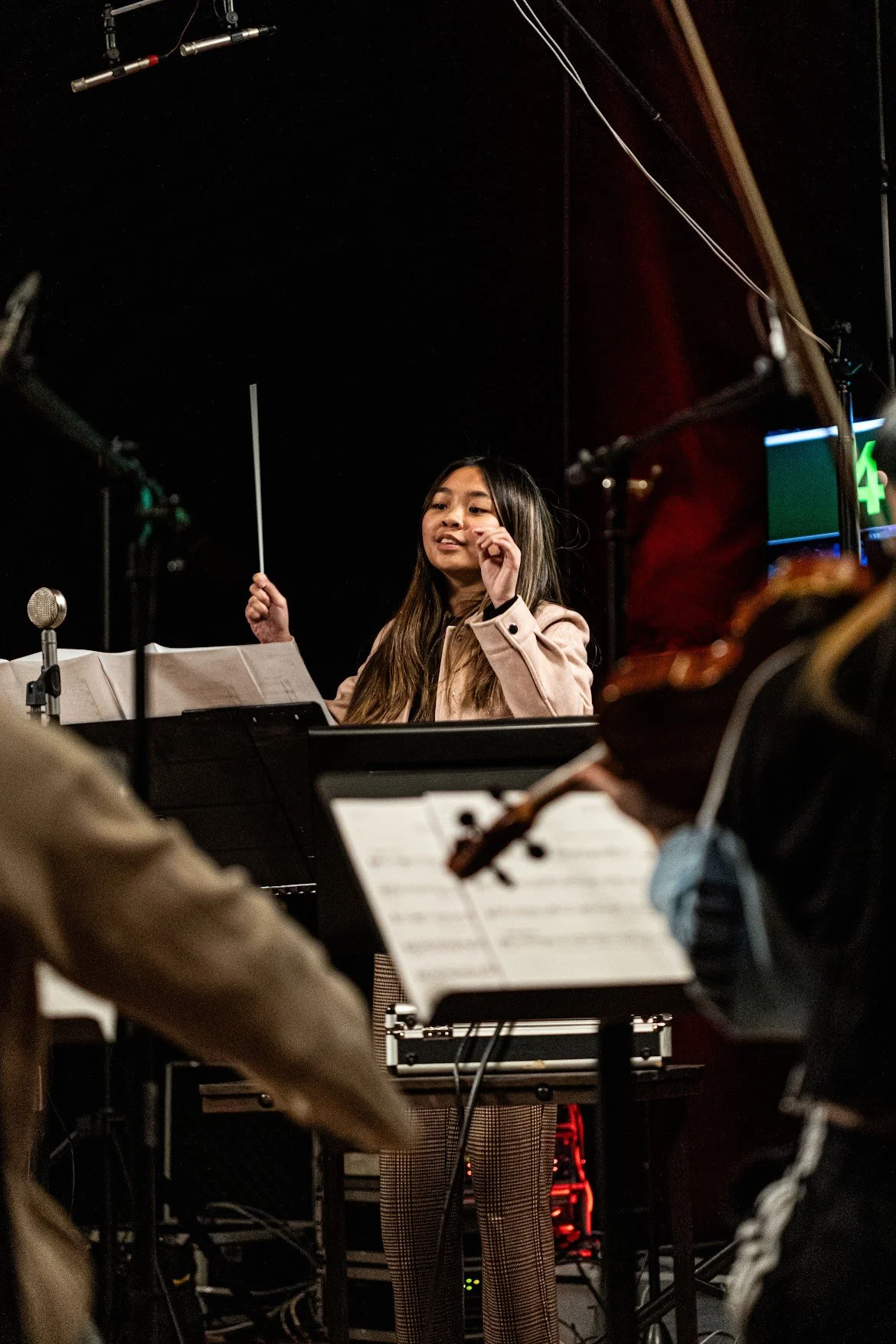
Charlene Soo conducts music from the composition she co-wrote for a short film. Photos submitted
By Tom Victoria
Charlene Soo is rocketing to a career in composing film scores.
The University of Southern California graduate already was recognized for composing the music to the short film Aftershock. Her score was nominated for Best Original Composition - Short Film category at the international Music+Sound Awards.
“Aftershock was one of the first films I scored after moving to L.A.,” she said. “I recently graduated from USC's Master in Screen Scoring and I got really great opportunities to work on very interesting, well-produced films.”
Charlene, 25, connected with the film’s director.
“Collin Nelson, who's the director of Aftershock, reached out to me,” she said. “The USC Rocket Propulsion Lab was aiming to make the highest and fastest civilian-made rocket. And he was planning on covering that and following its journey throughout. When he contacted me, he didn't even know if the rocket was going to be launched, so I didn't know if this documentary was going to be made.”
Fortunately for Charlene and the director, the project saw fruition.
“I was manifesting,” she said. “And then we got the news that they launched it successfully. I knew before it got on the mainstream news, which was really fun. I felt like an insider to everything.”
Charlene then went to work.
“When Collin first showed us the footage — he had GoPros attached to the rocket — I was like, this is amazing,” she said. “What are you thinking about for the score?”
He told Charlene he wanted a big orchestral sound.
“I was like, wonderful, well then we'll make that a reality,” she said. “For me, it was really surreal. I was expecting to work with a small ensemble, not a whole orchestra, but we made it happen.”
Charlene recruited a fellow composer to help with the project.
“He's this amazing composer and orchestrator,” she said. “I was like, hey, I think I'm gonna need some help on this given the tight deadlines. And he jumped on the project without hesitation. I wrote the main theme, showed it to my co-composer and Collin, and they both loved it. We ended up fleshing it out fully and recording it in Budapest with Budapest Scoring Orchestra, which was a privilege.”
Charlene was inspired by films with epic scores.
“All the influences came from Collin himself,” she said. “When he was putting together the rough cut of the film, he had temp music in there. It was music from Oppenheimer, Apollo 13 and all of these really big sci-fi movies like Interstellar and Dune. It was everything from electronic soundscapes to lush orchestral pieces”
Charlene worked remotely with the Budapest orchestra.
“We recorded certain parts of the score with them,” she said. “It was a 16-minute film and 15 minutes of it had music. Collin wanted music being a driving force in the documentary. And so we recorded five minutes of the score with the orchestra for the biggest moment: the launch scene.”
Charlene worked with other musicians closer to home for the remainder of the music.
“For the more intimate moments, we recorded with a smaller ensemble here in L.A. at Squeak E. Clean Studios in Hollywood,” she said. “They just opened, and we were their first ever string ensemble recording. We had musicians from Colburn (School) and from USC. It was really a fun process.”
Charlene relied on bombastic sounds.
“Horn is a major instrument featured throughout the soundtrack,” she said. “In the opening scene, we had a solo horn passage played by Dylan Hart. He's a brilliant player who has played on many big studio films, so that was also really exciting.”
Charlene’s love of music extends back to her childhood in Singapore.
“I was always in love with music, but the moment I became truly conscious of it was when I was 6,” she said. “One day in kindergarten, we learned that people who dance are called dancers. When I got home, I asked my mom whether people who sing are called singers. She said yes, and I remember thinking, okay, that’s what I want to be in the future. I want to be a singer.”
Charlene eventually shifted her focus.
“I spent a huge part of my teen years building a career as a singer-songwriter,” she said. “But when I got to undergrad in the UK and took a film scoring class in my final year, I discovered a medium of music, film scoring, that encompasses everything I love.”
Charlene found her calling.
“I love to sing, and I love writing melodies,” she said. “Film music is one medium where I can do both. I can write big melodic themes to highlight moments in films and tell a story through music, but I also have this incredible opportunity to write main title and end credit songs. With film scoring, I can hold onto the passions I had when I was younger while exploring an entirely new musical realm.”
Charlene left Singapore to attend undergraduate college in Liverpool before relocating to California.
“The main reason I moved here was because I really wanted to go to USC, which has one of the top film scoring programs in the world, and I wanted to live in L.A. where I could collaborate with really talented filmmakers,” she said.
Unlike some folks, Charlene likes the weather in England.
“I have always loved cold weather,” she said. “People always tell me that it's so cold and depressing in the UK, but I’ve always loved it. I thought the rain was the best thing ever.”
Charlene benefited personally by attending school in another country.
“I found myself,” she said. “I didn’t really know who I was when I was in Singapore. I was so young and still living at home. Moving abroad and pushing myself out of my comfort zone, I discovered so much about who I am. Solo traveling was something I never would have tried in Singapore, and I think those experiences deeply influenced my music.”
For Charlene, music was a beacon.
“To me, music means hope,” she said. “As a little girl in Singapore, music was always a form of escapism. I always believed that one day, music would lead me to where I was always meant to go.”
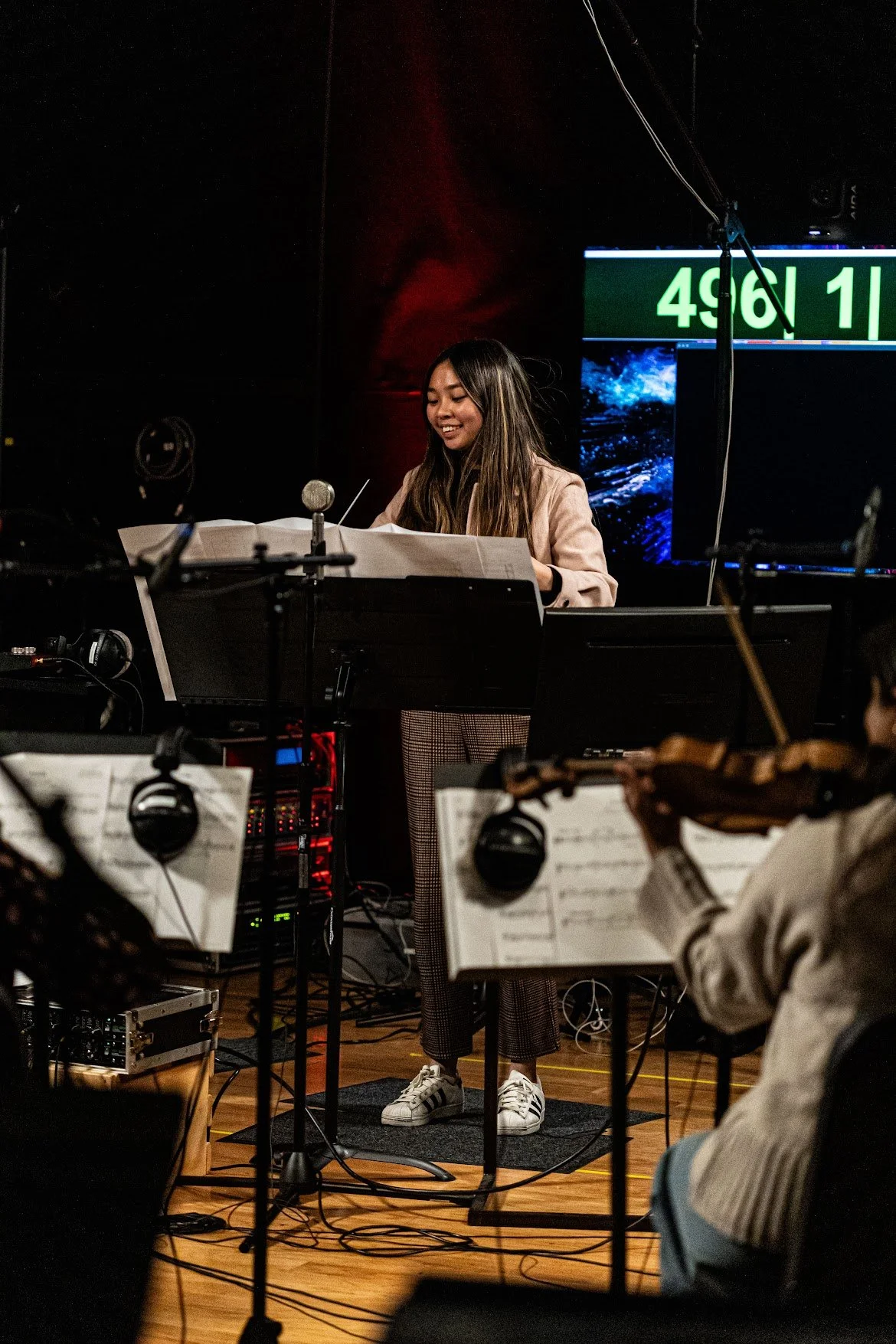
Charlene aspires to compose film scores and more.
“Not just film, games, TV shows, anything,” she said. “I’m a huge reader and I love books. I once read 111 novels in one year. One day, I hope to have one of those novels adapted into a movie and leave my own original mark on it. That would be my dream.”
Charlene would enjoy making music for a variety of genres.
“One thing I love so much about film scoring in school is the opportunity to compose for so many different kinds of projects be it a fantasy, sci-fi or rom-com,” she said. “I really enjoy the challenge of writing in different styles. Even right now, I’m working on three films, and they’re all completely different from one another, genre-wise.”
Another genre also appeals to Charlene.
“I really do love fantasy,” she said. “If there’s a Lord of the Rings-level epic, anything with dragons or that sort of grand, adventurous world, it would be an absolute dream. Really, anything that comes my way, I’d be thrilled to score.”
As a child, Charlene was inspired by the score to the movie adaption of the classic Michael Crichton novel.
“When I was younger, I was at a theme park and heard the Jurassic Park soundtrack for the first time,” she said. “I didn’t even know what film music was. This was my first memory of it. I was at the Jurassic World section, and then I heard John Williams’ theme from Jurassic Park. I fell in love with the melody. I just love the idea of writing a melody, having it associated with a character in a film and having people remember it forever.”
Charlene said music is a way to express herself unlike any other.
“Whenever you write a song or a piece of music, you can put yourself in it and nobody needs to know how deeply personal it truly is,” she said. “The beauty is that when other people listen, if it resonates with them, they bring their own narrative to the lyrics or the piece itself. Even though I’m telling my story, it becomes someone else’s story, too. I like to put a piece of myself in everything I write and if someone knows me well enough, they can decipher it.”
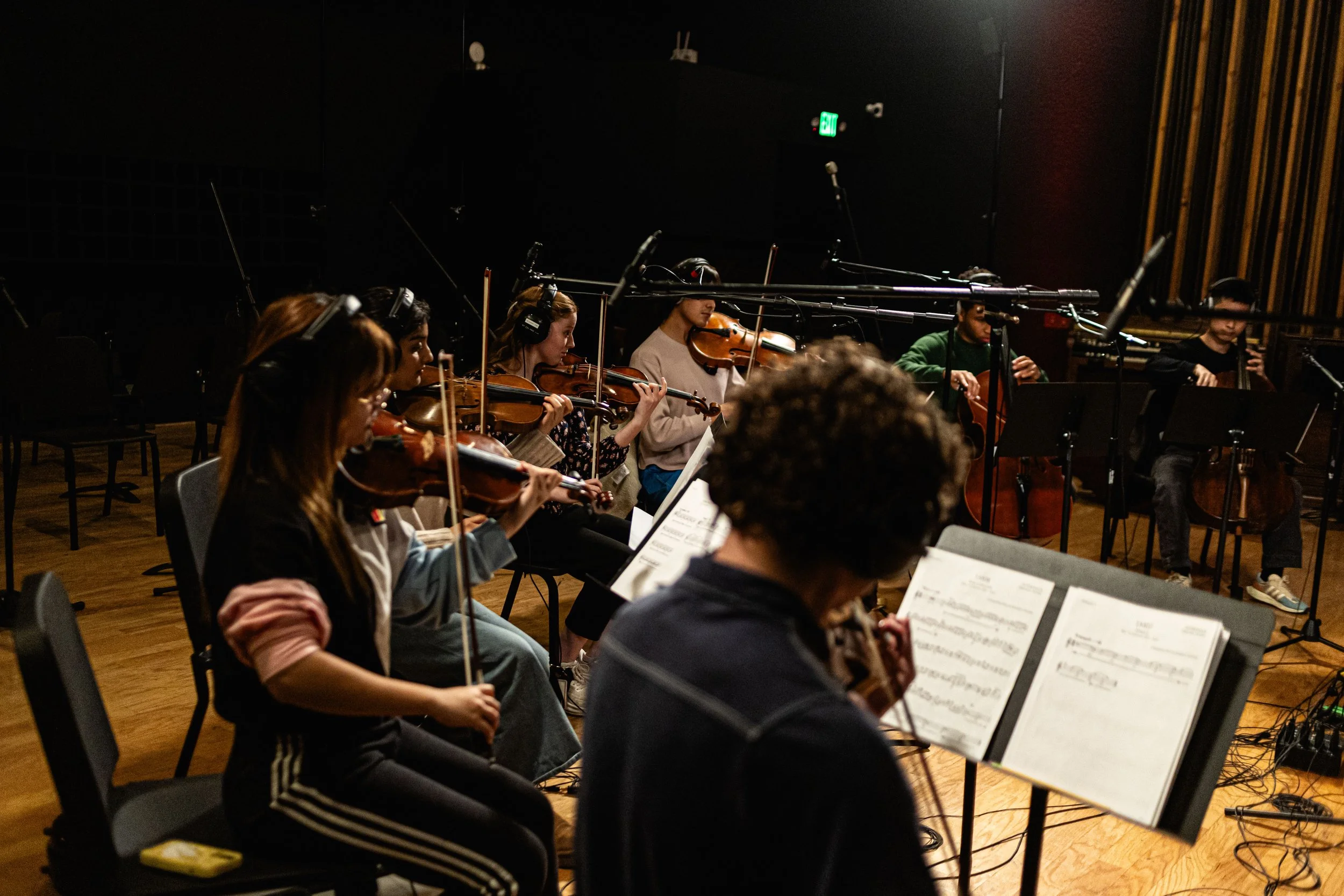
Musicians perform the music for Afterhsock.
Charlene hopes to be remembered someday for her music.
“For my melodies, without a doubt,” she said. “In the same way John Williams is known for his themes and melodies, I really want to leave my own mark. I love writing themes and melodies. It’s the essence of who I am as a composer. I just hope that one day my melodies will resonate with people.”
Just receiving a nomination for such a prestigious award was a big boost to Charlene’s burgeoning career.
“I submitted a medley of music from Aftershock and forgot about it for a while,” she said. “Then I got the nomination, and I was like, no way. My first thought was how meaningful it was that one of the first films I scored since moving to L.A. was nominated alongside incredible composers like Hans Zimmer and Ludwig Göransson. Also, in my category, last year’s winners went on to win the Oscar for Best Short Film. It’s such an incredible honor.”
Charlene said awards are a bonus.
“I don’t write music to win awards,” she said. “I write music in the hope that people will resonate with it and find comfort, just as I always have with my favorite composers and songwriters.”
Charlene stays motivated to make music, but is glad to have help on occasion.
“It helps to have two people on a project,” she said. “I co-compose a lot with my collaborator on Aftershock, Andreu Diport. That’s where having two people really makes a difference. If there’s a day when I feel like, nah, today is a one-brain-cell day. I have no good ideas and don’t want to do this anymore, there’s always someone else to pick up the slack. And there are days when he feels the same way, so we balance each other out and keep the work moving.”
Charlene always keeps the end goal in sight.
“A lot of it is knowing there’s a deadline and convincing myself, over and over again, that one day we’ll get past the finish line,” she said. “I just need to work toward that date and give it my best effort, and that’s all I need to push myself. With Aftershock, we had an extremely tight deadline. We had one week to write all of the orchestral music. We didn’t sleep much, but we made it happen. And that’s what matters.”
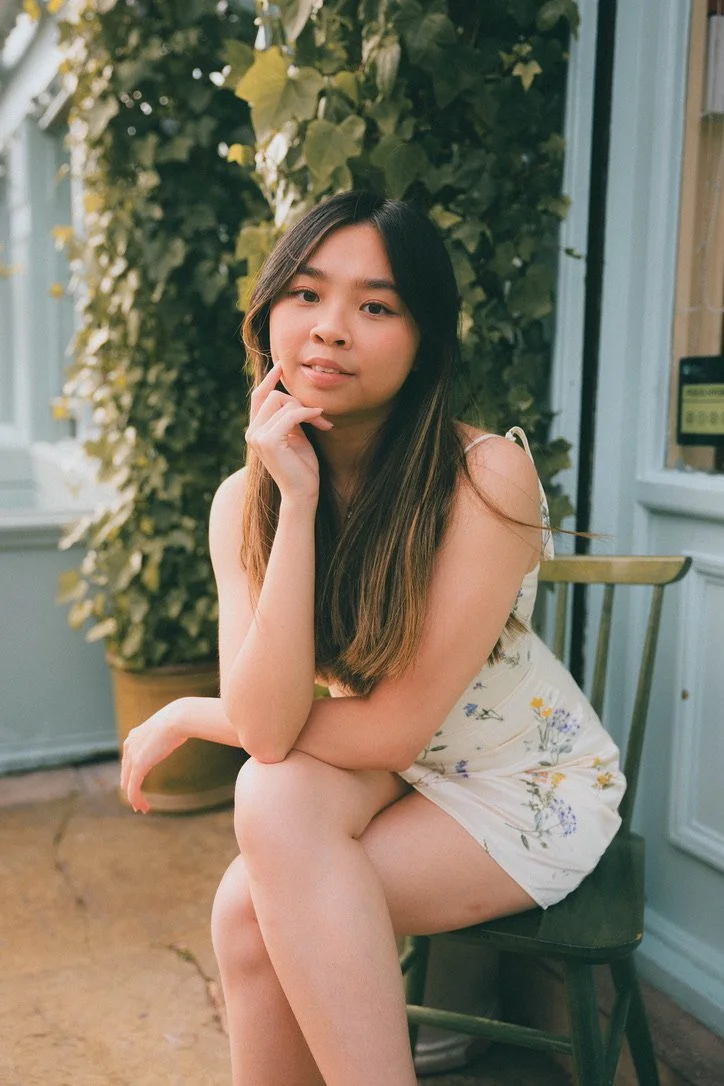
“More often than not, when you feel like giving up, you’ll get a lot of people saying don’t do it or you’ll feel pressure to quit. Well, if you feel pressure, that means you’re rising. You’re pushing yourself beyond your comfort zone, which is a good thing.”
Charlene dispensed advice to aspiring composers.
“I’m gonna steal this,” she said. “I saw Taylor Swift give a speech when she won an award, and one line that always resonated with me is: if you feel pressure, you’re rising. More often than not, when you feel like giving up, you’ll get a lot of people saying don’t do it or you’ll feel pressure to quit. Well, if you feel pressure, that means you’re rising. You’re pushing yourself beyond your comfort zone, which is a good thing.”
Another line also resonated with Charlene.
“People are entitled to think whatever they want, but you’re also entitled to prove them wrong,” she said. “That’s such a great line, and it’s something I always remind myself: people can say whatever they want about you, but you can also use that as fuel and work hard to prove them wrong and most importantly, prove that little voice inside of you wrong.”